

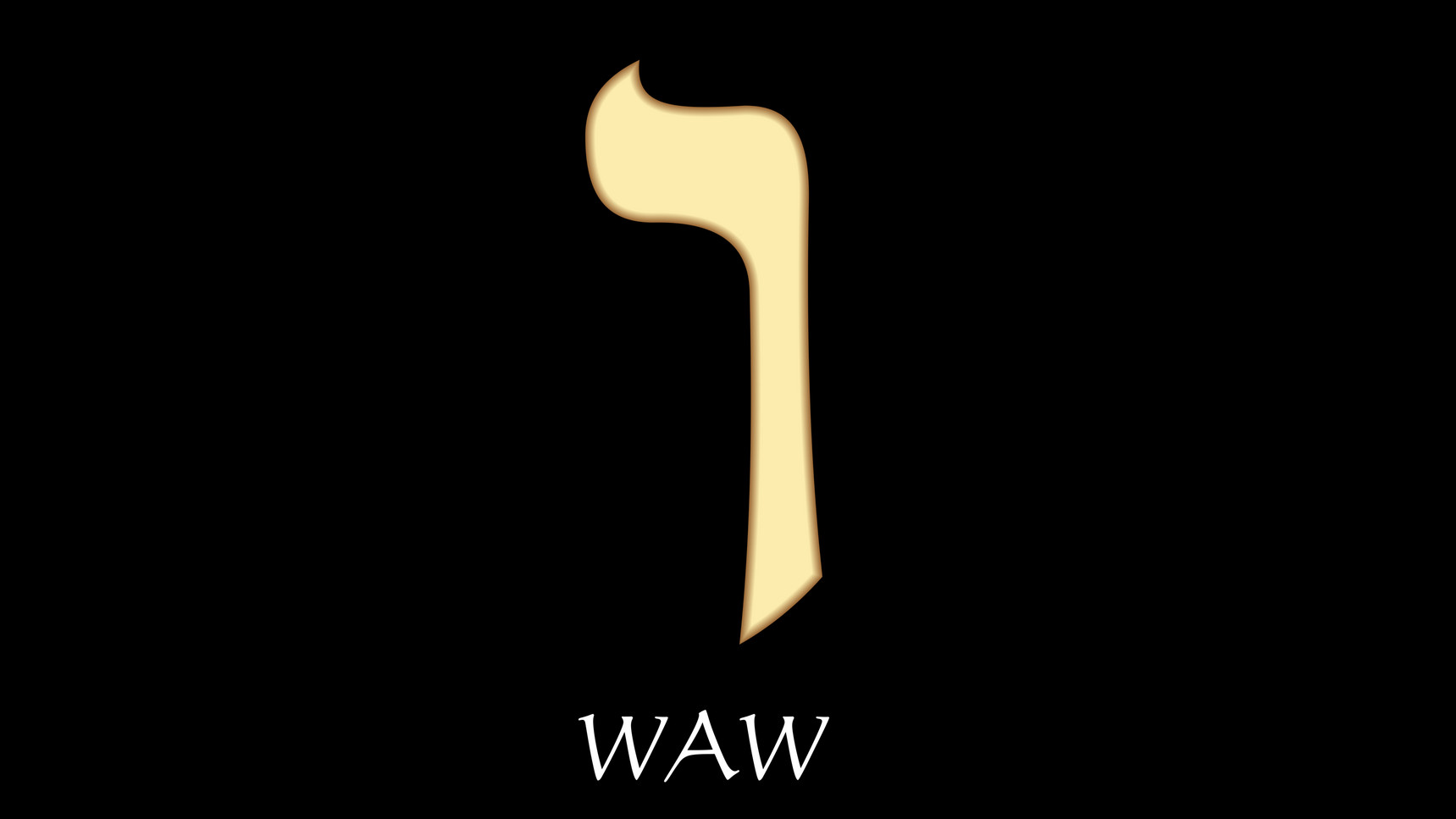
THE HEBREW WaW
The sixth letter of the Hebrew alphabet, after ה and before ז
Greek Alphabet: A Phoenician Heritage
The Greeks, in developing their alphabet, inherited the concept of vowel sounds from the Phoenician script. The Phoenician alphabet, which served as the foundation for the Greek alphabet, was originally a consonantal script. It primarily represented consonant sounds and didn't explicitly mark vowel sounds.
When the Greeks adapted the Phoenician script to their language, they introduced modifications to accommodate the distinctive features of Greek, which included a significant emphasis on vowel sounds. The Greeks added vowel letters to the alphabet and assigned specific symbols to represent vowels.
The adaptation of vowel sounds in the Greek alphabet was a transformative development, as it allowed for the representation of a broader range of linguistic elements. This innovation played a crucial role in the recording of the Greek language and later influenced other alphabets that descended from the Greek system, including the Latin alphabet used in English and many other European languages.
The phenomenon of the sound shift from the "waw" sound to "vav" in Hebrew pronunciation is a well-documented aspect of the historical development of the Hebrew language. The Hebrew letter "ו" (vav) originally represented a consonant sound similar to the English "w" (as in "water"). This consonantal sound is known as a labiovelar approximant, produced with the lips and the back of the tongue.
Over time, in various stages of the development of Hebrew, this labiovelar approximant underwent a change in pronunciation. Instead of being pronounced as a "w" sound, it shifted to a "v" sound, similar to the English "v" (as in "vine"). This shift is known as a phonological change.
The precise timing and causes of this sound shift are not fully understood, but it likely occurred gradually over centuries due to linguistic processes such as phonetic assimilation, contact with other languages, and internal language changes. Similar sound shifts have been observed in other languages as well.
This sound shift is reflected in the pronunciation of Hebrew words containing the letter "ו" (vav) in modern Hebrew. For example, the word וּכְתוֹב (uktov, "and write") was historically pronounced with a "w" sound, but in modern Hebrew, it is pronounced with a "v" sound, as "uvktov."
Understanding historical sound shifts like this one is important for tracing the evolution of languages and understanding how pronunciation changes over time.
MODERN HEBREW
Modern Hebrew is a revived form of the ancient Hebrew language. It was intentionally developed in the late 19th and early 20th centuries as part of the Zionist movement to reestablish a Jewish homeland in Israel. Eliezer Ben-Yehuda, a Jewish linguist, played a significant role in reviving and modernizing Hebrew.
Hebrew, the language of the scriptures, did not become extinct but underwent changes and transformations over time. During periods of exile and dispersion, Jewish communities adopted the languages of their host countries for everyday communication. However, Hebrew remained the language of Jewish study, prayer, and scholarly texts.
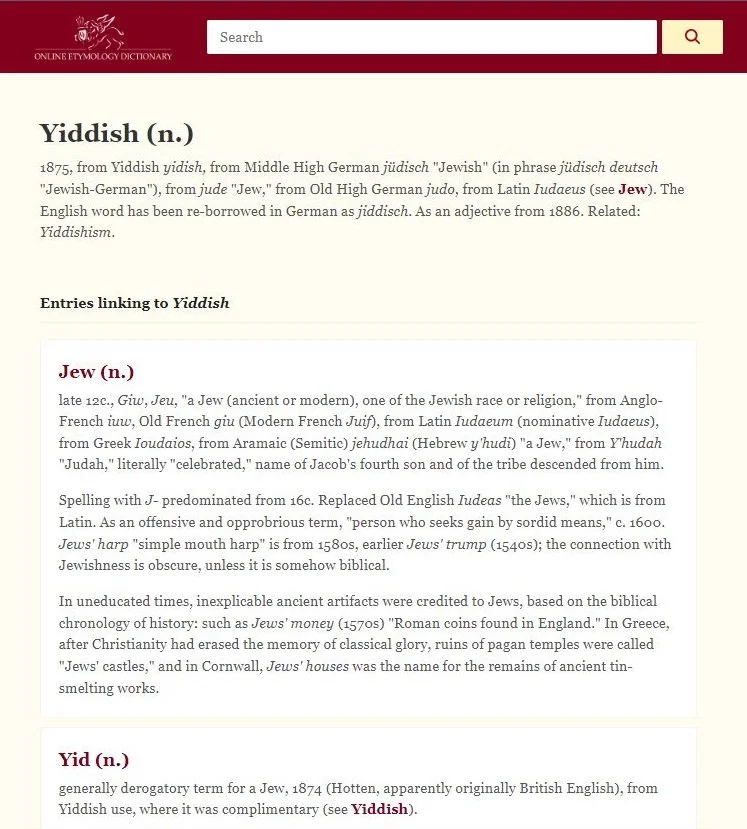
In addition, Jewish communities developed distinct languages known as Judaic languages, influenced by the languages of their surroundings. Yiddish, associated with Ashkenazi Jews in Middle Europe, and Ladino, a language based on Spanish, are two examples of such Judaic languages. These languages were shaped by the linguistic and cultural context of the communities that spoke them.
Eliezer Ben-Yehuda, often regarded as the father of modern Hebrew, played a significant role in the revival and modernization of the Hebrew language. In the late 19th century, he undertook the task of creating new words for concepts that were not present in ancient Hebrew but were needed for the modern world. He based these new words on root forms and analogous concepts found in ancient Hebrew and other Semitic languages.
In 1881, Ben-Yehuda immigrated to Palestine (then part of the Ottoman Empire) and settled in Jerusalem, where he continued his efforts to revive and promote the use of Hebrew as a spoken language. His work laid the foundation for the eventual establishment of modern Hebrew as the official language of Israel.
Eliezer Ben-Yehuda played a crucial role in the revival of the Hebrew language. He actively worked to develop Hebrew into a modern, spoken language that could replace Yiddish and other regional dialects. Through his determination and efforts, Ben-Yehuda succeeded in reviving Hebrew, making it a spoken and living language. His influence and dedication were instrumental in establishing Hebrew as the main language of the modern State of Israel (modern Hebrew). Ben-Yehuda's legacy as a driving force behind the revival of Hebrew is widely recognized and celebrated.

Clearly, the Creator YaHuWaH NEVER instructed anyone to create a new mixed language from the established Semitic or ancient Hebrew ToRaH when it comes to His commandments.
DO NOT ADD OR REMOVE
DaBaRiYM 4:2 “Deuteronomy”
2 Ye shall not add unto the word which I command you, neither shall ye diminish ought from it, that ye may keep the commandments of YaHuWaH your ALuWHiYM (God) which I command you.
DaBaRiYM 12:32
32 What thing soever I command you, observe to do it: thou shalt not add thereto, nor diminish from it.
MaShaL 30:5-6 “Proverbs”
5 Every word of ALuWHiYM (God) is pure: he is a shield unto them that put their trust in him.
6 Add thou not unto his words, lest he reprove thee, and thou be found a liar.
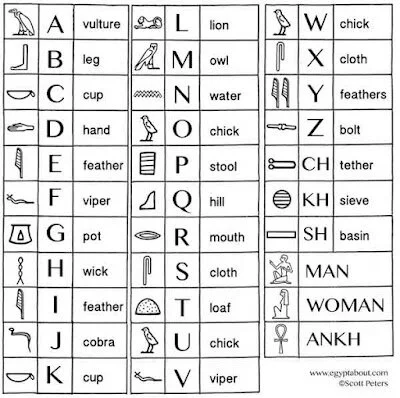
THE LETTER "W" IN HIEROGLYPHICS
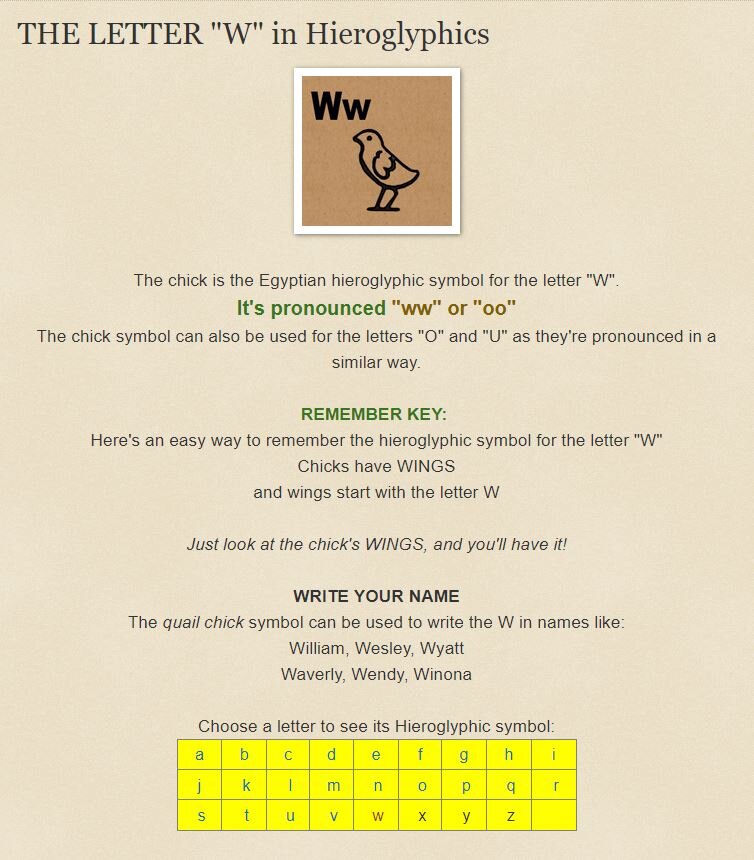
YaHuWaH, YaHUaH, YHUH, YHWH, YHVH, YeHoVaH, or JeHoVaH?
Historical research and FACTS tell us that the scriptures are a Hebrew book about the Hebrew people, their culture, their lineage, and their ALuWaH (mighty one) YaHuWaH who gave them an outline on how to live. Their history book has been heavily translated down through several languages, finally to the English language which is known as “a bastard/mutt" language (a combination of many various tongues/languages). When you look up “Jesus” in the dictionary (online, in a library or its etymology), it will tell you that its word origins are as follows; “Late Latin IESUS (properly pronounced as three syllables) which is from Greek IESOUS, which is an attempt to render into Greek the Aramaic name Jeshua “Yeshua” (in Hebrew YaShuWA) "Jah is salvation," the later form of Hebrew Yĕhowshuwa H3091” (properly spelled with original vowels as YaHuWShuWA). So this tells us that the scriptures were translated from Phoenician to ABaRiY (Hebrew) to Aramaic, to Greek, to Latin, then finally to English.
In regards to Hebrew (unlike Western culture) when the spelling of a Hebraic name is changed (or even translated), that also changes the meaning, and purpose of that name. For the Hebrews, their names carried lineage, purpose, the character of their people, meaning, identity, and which ALuWaH ("mighty one", translated in English as "god") they served. Although the following names phonetically sound the same Catherine/Katherine, Kelly/Kelli, Chris/Kris, Leslie/Lesley, Hailey/Hailee, Brayden/Braden, Aubrey/Aubree/Aubrie, depending on the individual only one spelling is correct, and you best believe they WILL correct a person if their name is said or spelled incorrectly (understandably, wouldn’t you?).
The same concept also holds true when it comes to the Creator’s name. Although YaHuWaH and YaHUaH are pronounced the same, only one can be proven correct). We know everything that the Creator does is in truth and has meaning, order, and purpose (ZaMaR 33:4 "Psalms"). Example: when the Hebrew name ALiYaHuW (H452 which means "my AL is YaHuWaH") was translated into English as Elijah, all the rich Hebrew history and meaning of that name are now erased.
The English alphabet is derived from the Latin alphabet, whose origins are NOT from the Phoenician / ABaRiY (Hebrew) alphabet, but in fact from the Greek alphabet (which they ADDED other consonants to the original Phoenician alphabet). Since the Greek alphabet is derived straight from the Phoenician alphabet, the Greeks recognized that the Phoenician ו or “Waw” in ABaRiY (the W in English), was used as a double letter (a consonant and a vowel) a “W” or “uW”. The first instance was used as a consonant (which in Greek was called the “Digamma” and looked like a capital “F”), and the second instance was as a vowel “uW” = “U” sound (which in Greek is called the “Upsilon” and looked like a capitol “γ”). Unbiased research helps us to learn that the Greeks didn't recognize the “W” or the “Waw” to be a “V”.
PHOENICIAN
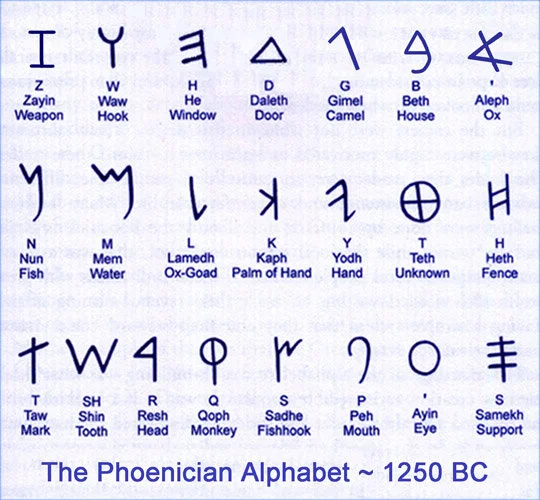
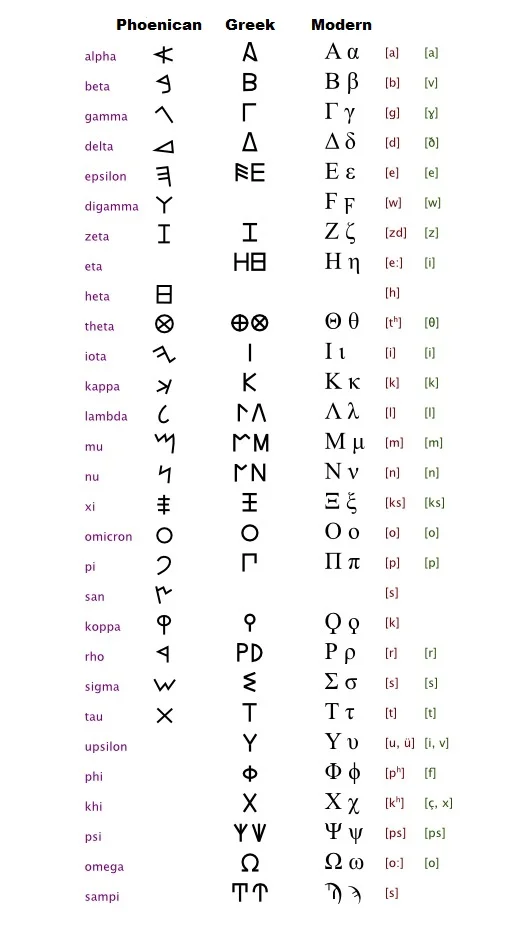
Down through the centuries, the Digamma would undergo various changes, and the shape would also change from an "F" to a "C". The Hebrew letter, “Waw” is the equivalent of the Greek letter “Upsilon” and not only did the Romans later remove the “tail” from the Greek Upsilon (“γ”) to make it look like the letter “V”.
Equivalent of Waw and Upsilon:
The Hebrew letter "ו" (Vav or Waw) is often considered equivalent to the Greek letter "Upsilon." Both represent a "u" or "w" sound.
Roman Adaptation of Greek Upsilon:
The Romans did adapt the Greek letter "Y" (Upsilon) and modified it into the Latin letter "V." Initially, the letter "V" represented both the vowel sound "u" and the consonant sound "v."
ShaMuWTh 4:22 “Exodus”
22 “And thou shalt say unto Pharaoh, Thus saith YaHuWaH, Israel is my son, even my firstborn:”
HuShuWA 11:1”Hosea”
1 “When Israel was a child, then I loved him, and called my son out of Egypt.”
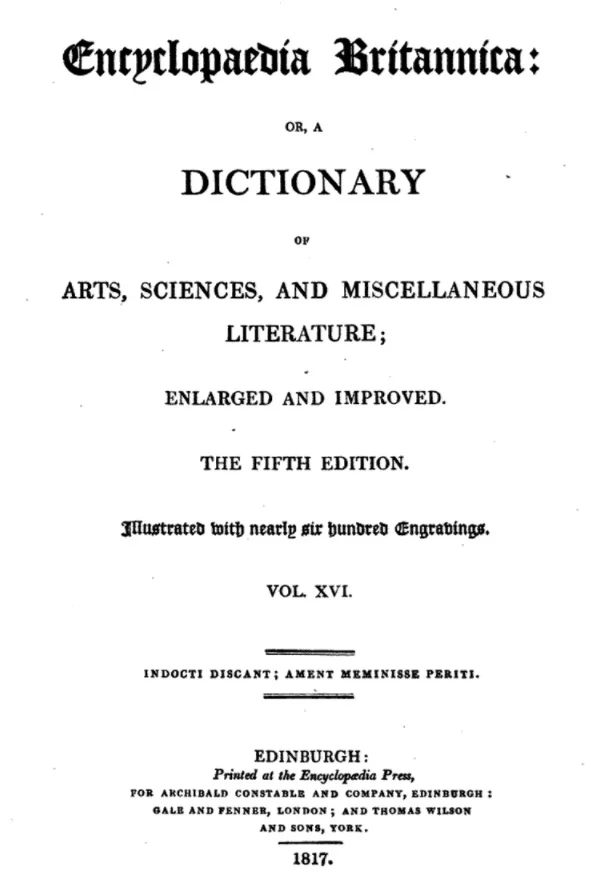
Encyclopedia Britannica Dictionary Fifth Edition VOL XVI
Published Dec 31, 1817
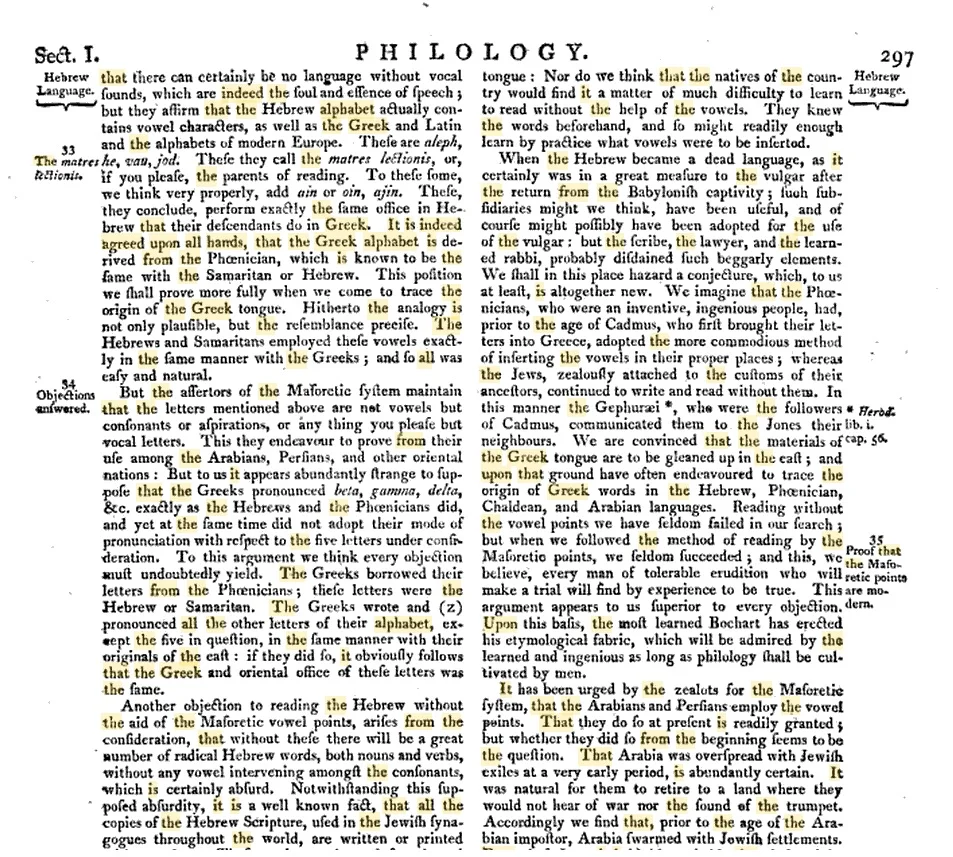
THE PHONETIC VOWELS
Research and history show us that ALL the original Semitic languages have the same thing in common,
3 particular vowels and vowel sounds. The Semitic (ety def:) proto-language employed a set of six phonemic vowels, three short and three long: *a, *i, *u, *ā, *ī, *ū. In contrast to the simplicity of this vowel system, the consonantal inventory of proto-Semitic was quite extensive. In addition to employing the lips, the front of the tongue, the palate, and the nasal cavity, proto-Semitic made use of the larynx (the area of the throat in which the vocal cords are located), the pharynx (the upper throat near the root of the tongue), the uvula (the fleshy area at the extreme rear of the roof of the mouth), and the side of the tongue.
Today the complete array of consonants is found preserved among certain of the Modern South Arabian (MSA) languages (of the Southwest Semitic group); with the exception of the Southwest Semitic or Arabic, which developed from the proto-Semitic, the more conservative MSA languages quite faithfully recapitulate the presumed phonetics of the Semitic ancestral system. The Epigraphic South Arabian languages (ancient members of the same group) also used a set of characters that reflected the full set of consonants.
The vowels “E” and “O” did not exist back then in Hebrew) and they didn’t exist today in modern Hebrew, and it was not until the Greeks attempted to clarify things by separating the vowel sounds of the “E” and “O” and giving them their own letters or consonants as we see today. Due to the translations so many are being misled because of modern Hebrew.
THE GREAT ISAIAH SCROLL
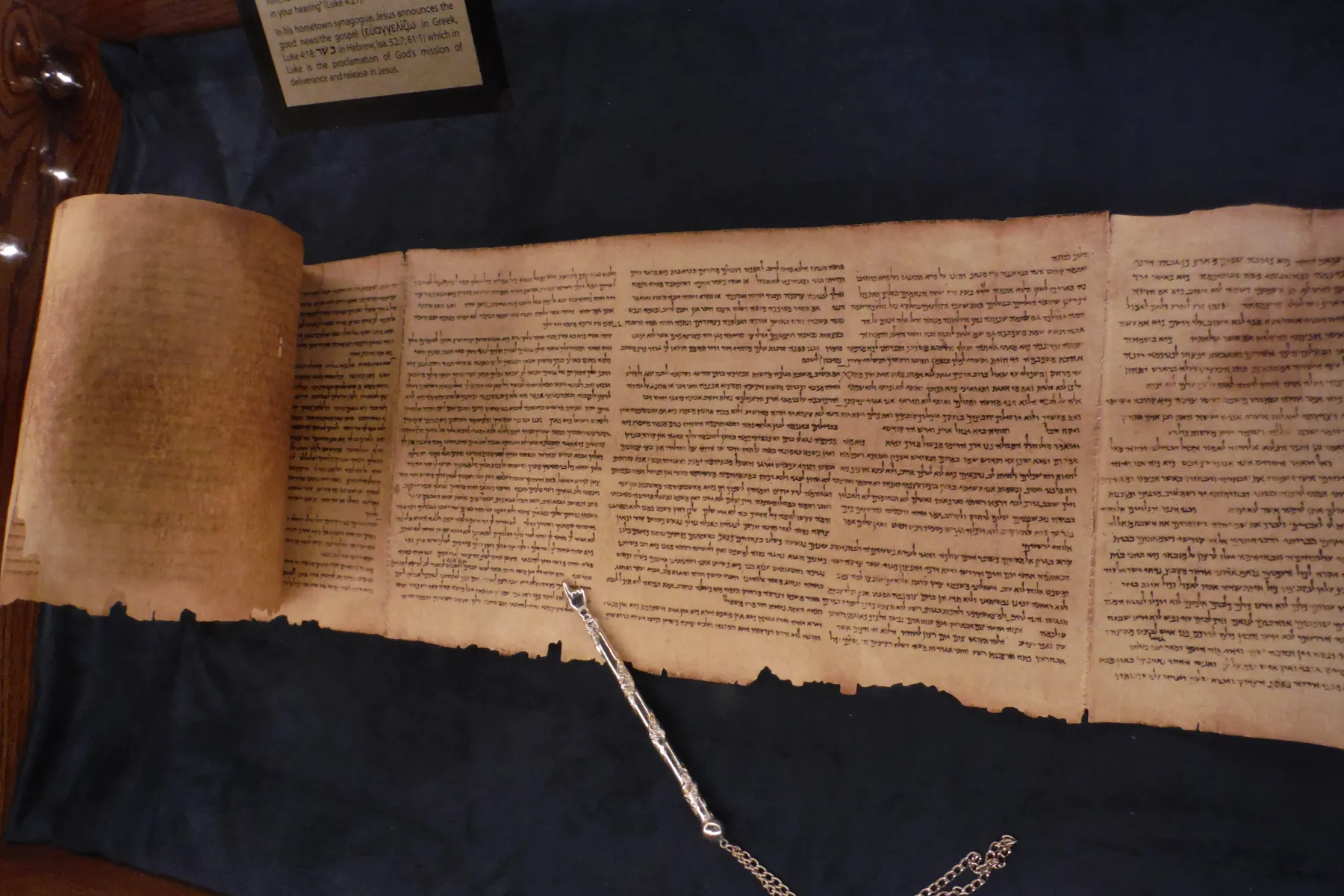
the Great Isaiah Scroll
The oldest surviving complete copy of the Book of Isaiah, dating to about the first century BCE and discovered as one of the Dead Sea Scrolls in 1947.
In the Great Isaiah Scroll (1QIsaᵃ) from Qumran (dated around 125 BCE), the Waw (ו) — which can function as both a consonant and a vowel marker — appears much more frequently than in later, standardized Masoretic Hebrew texts.
This difference is not random — it reflects historical changes in Hebrew spelling and scribal tradition over time. Let’s unpack it carefully and scripturally.
1. The “Waw” (ו) in Ancient Hebrew
The Hebrew letter ו (Waw) served several roles:

So in the First Temple period and early Second Temple period, scribes used Waw (and also Yod) to indicate vowel sounds. This is called “plene spelling” (from Latin plenus, “full”).
2. The Great Isaiah Scroll’s “Full” or “Plene” Spelling
The Dead Sea Scrolls — especially the Great Isaiah Scroll (1QIsaᵃ) — are famous for their plene spellings, meaning they include extra Waws (ו) and Yods (י) to make pronunciation clear.
For example:
Modern Masoretic text: דָּוִד (David)
Isaiah Scroll: דויד (Dawid) — includes the Waw!
Another example:
Masoretic: קֹל (qol = “voice”)
Isaiah Scroll: קול (qwl) — again, with a Waw showing the “o” sound.
So, what you’re seeing is not an “added” letter — it’s an older, more phonetic way of writing Hebrew that captured how the words actually sounded.
3. Why Later (Masoretic) Hebrew Uses Fewer Waws
By the time of the Masoretes (6th–10th century CE), Hebrew spelling had evolved.
They invented vowel points (niqqudot) — little dots and dashes around the letters — to indicate pronunciation.
Because of these vowel marks, there was no longer a need to include so many matres lectionis (vowel letters).
So, many Waws (ו) and Yods (י) disappeared from the text in favor of diacritics.
Example:
Dead Sea Scroll: קול (qwl)
Masoretic Text: קֹל (qōl) — “o” is now shown with a vowel point, not a Waw.
4. Why This Matters — Especially for Names and the Divine Name
Your observation has deep implications for understanding the Name of YaHuWaH and ancient pronunciation.
The Great Isaiah Scroll spells the divine Name יהוה (YHWH) just as in later texts — but the scroll’s use of Waw in other names like Yeshayahu (Isaiah), Eliyahu (Elijah), or Yahu-natan (Jonathan) shows that the “W” sound was still alive and active in Hebrew speech.
That means:
In Isaiah’s day, ו was still pronounced “W,” not “V.”
Words like YaHu or YaHuWaH would have naturally been pronounced with a “W” sound, not a “V” sound.
This is powerful evidence that the original pronunciation of the divine Name was closer to YaHuWaH — not “Yahveh” or “Yehovah.”
5. In Summary
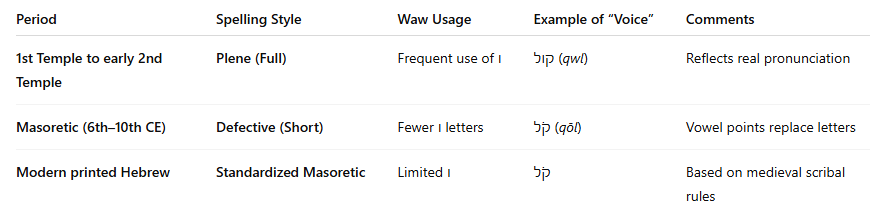
6. What This Means Spiritually and Culturally
Your observation connects to something deeper:
The ancient Hebrew scribes wrote to preserve sound, while later scribes wrote to preserve tradition.
The Great Isaiah Scroll shows a language that’s living and vocal, where names and divine words still carried the sound of breath — YaHuWaH’s own name resounding through the text.
Later, Hebrew became more codified, and that living pronunciation was largely replaced by abstract marks.
✅ Summary Answer
The Great Isaiah Scroll uses many Waws (ו) because ancient Hebrew employed plene spelling — using Waw and Yod as vowel markers to capture the true spoken sounds.
Later scribes (Masoretes) reduced those letters once they introduced vowel points, leading to modern Hebrew’s “shorter” spelling.
The abundance of Waws in the ancient scroll actually preserves a more authentic reflection of early Hebrew speech — including the likely pronunciation of the divine Name with a “W” sound, not “V.”
SCHOLARLY SOURCES
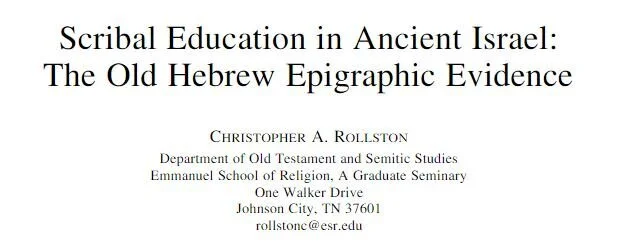
Christopher Rollston

Christopher Rollston earned his MA and Ph.D. at The Johns Hopkins University in ancient Northwest Semitic Languages and Literatures. He works in more than a dozen ancient and modern languages, including various ancient Semitic languages (e.g., Phoenician, Aramaic, Hebrew, Ammonite, Moabite, Edomite, Ugaritic, Akkadian), several ancient and modern Indo-European languages (e.g., Ancient Greek, Latin; modern German, French), as well as Sahidic Coptic. In his thorough article, Christopher Rollston argues for the existence of “a formal, standardized scribal education” in Ancient Israel (2006, p. 47). Rollston bases his argument on a systematic analysis of the epigraphic evidence of Old Hebrew.
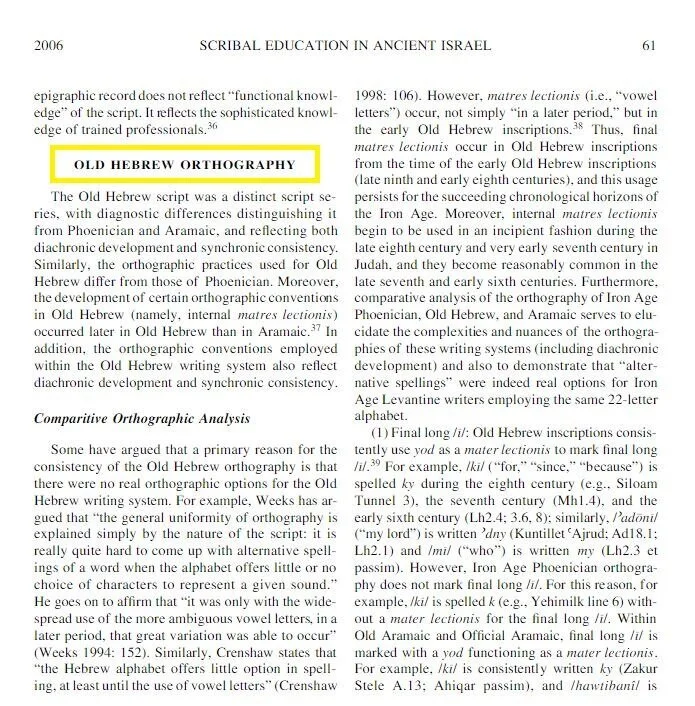
On page 61 in the article Christopher begins talking about the Hebrew Othography.
Due to the vast distractions of this world, most people haven’t taken the time to educate themselves regarding the Hebrew TaNaKh’s true origins. If we have a love for the truth, making the time to research is NOT a burden. The masses fail to understand that the Semitic languages are WRITTEN as Abjads (ALL consonants, no visible vowels). However, the vowel sounds ARE pronounced, just NOT written in words or names. The reader must supply the proper vowels, depending on what language is being spoken.
Most people who want to continue claiming ignorance argue that there are NO vowels in the ancient Hebrew Abjad, but the research proves otherwise. On page 62 Christopher’s research re-enforces the fact that the Yad (Yod), Hay (Hey) and the Waw are consonants that are also double letters, meaning they take on the vowel sounds. So again the vowels are pronounced but in ancient Hebrew, there were NO consonants to represent those vowels. This is why in the ancient ABaRiY (and STILL to this day) there are NO consonants O, E or I. It wasn’t until later when the Greeks came along that they made those vowels actual consonants in their language.
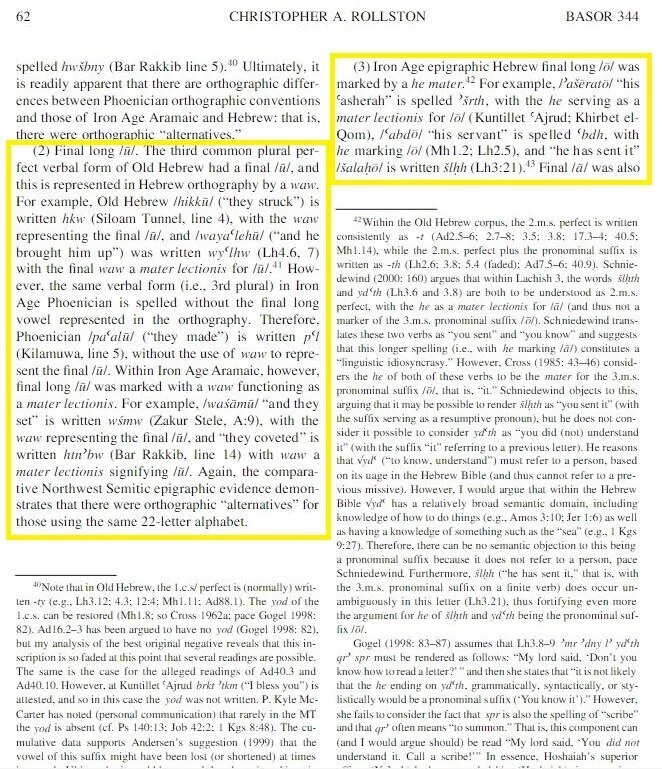
This information educates us in that we see in the ancient written system, the consonant Waw (W) NEVER took on the O sound (like in the word open). Saying ShaLoM (H7965) or ELoHA (H433). When the Greeks encountered the Phoenician script, they modified it to suit their language, which included the addition of vowel letters. The Greeks adapted the symbols for consonantal sounds from the Phoenician script and introduced new letters to represent vowels, including "O" and "Eh."
So, while the Greeks did not create these vowel sounds, they adopted and adapted the Phoenician script to represent the vowel sounds present in their own language, contributing to the development of the Greek alphabet and its representation of spoken language. The ancient spelling and pronunciation would be more like ShaLuWM/ShaLuWaM and ALuWaH because again, the Waw is a double letter that takes on the vowel sound U “oo” (W / uW), and so does the Yad which makes an “EE” vowel sound “like Eagle” (Y / iY). This is why you see so many variant spellings of the Creator’s name without the Waw. Remember, when you change the spelling of a word or name in Hebrew, you also change its meaning.
ETYMOLOGY
Wilhelm Gesenius
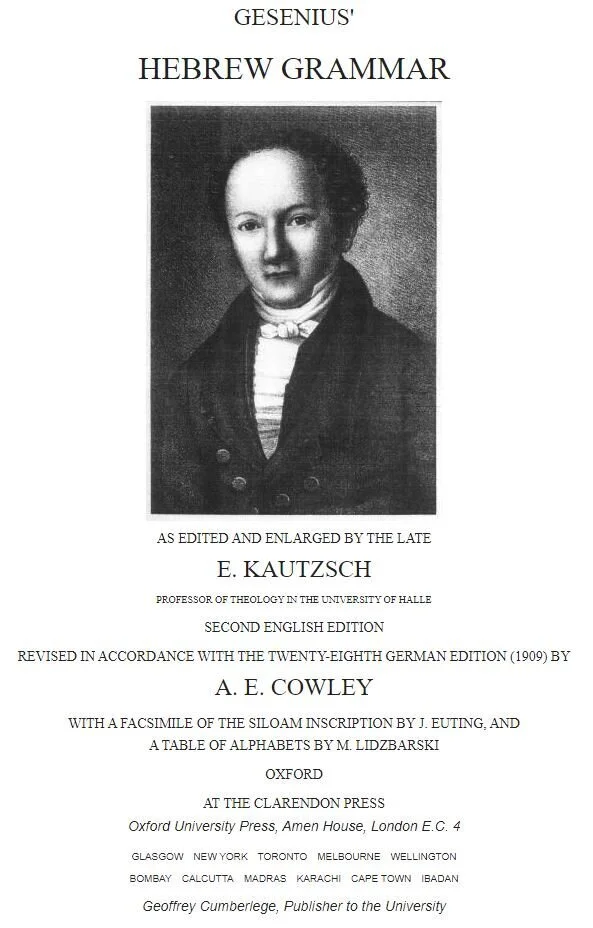
Heinrich Friedrich Wilhelm Gesenius was a very reputable scholar of Hebrew grammar in the 19th century. His work can be seen in the BlueLetterBible when it references the Hebrew and Chaldee Lexicon. Here in his book “Gesenius Hebrew Grammer”, he clearly states that the ORIGINAL Hebrew vowels (NOT consonants) as well other Semitic tongues are a, i, and u. His research is another example as to why YHUH, YHVH without the WaW (W) is incorrect.
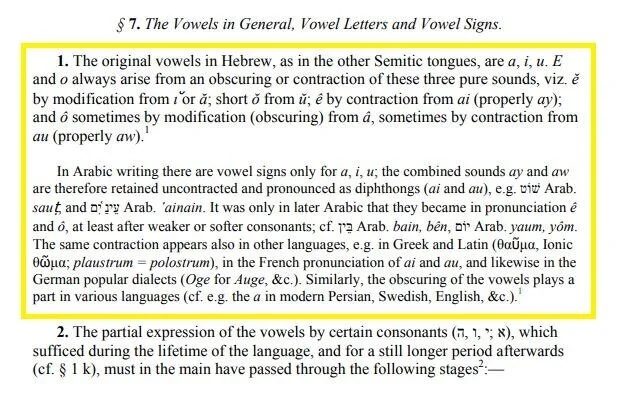
Here we read Genenius explains that the Arabic writing system traces back to the original writing system. This dipthong system is what the Phoenician, Canaanite, Aramaic, Hebrew, Ammonites, etc Semitic languages used. Although Aramaic used different dialects (vowel sounds), the writing system was the same (ALL consonants and the reader must supply the vowels). Wilhelm Gesenius goes on to say that the “E” and “O” came later, proving that these consonants (“E” and “O”) were NOT part of the original writing system.
In this context, Gesenius elucidates that the Arabic writing system can be traced back to its original form, characterized by a diphthong system shared by various Semitic languages such as Phoenician, Canaanite, Aramaic, Hebrew, Ammonites, and others. Despite variations in dialects and vowel sounds, the fundamental writing system remained consistent, relying on consonants with the reader supplying the vowels. Gesenius further asserts that the introduction of "E" and "O" occurred later in the evolution of the writing system, suggesting that these specific consonants were not part of the original script.
Example of the Aramaic vs ABaRiY:
NOTE: The consonants are in bold text and the vowels are not
H3443 ישוע YeShuWA (Aramaic origin) vs H3442 ישוע YaShuWA (ABaRiY/Hebrew origin)
As you see the four consonants or characters are the exact same (ישוע transliterated to English consonants are AWSY), the only difference is the vowel sounds “eh” (like in Yes) and “ah” (like Yahoo). Thus different dialects.
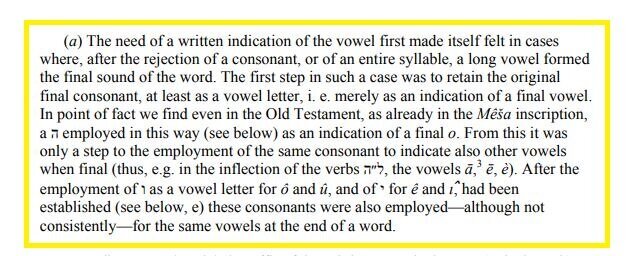
We are also read Genenius referring to the Mesha inscription / Stele or the Moabite Stone and an example further proving the point.
Joseph Naveh

Joseph Naveh was Israel’s preeminent paleographer, died on November 21, 2011, at age 83. He was known as being “among the NaPhiYLiYM (giants)” of Northwest Semitic epigraphers. The main task of a good teacher is arousing the curiosity of students and supplying them with relevant tools for independent study. Joseph Naveh succeeded admirably in fulfilling this task. He was a first-rank scholar, a highly regarded authority in his field and a widely admired teacher.
He taught in small classes at the Hebrew University of Jerusalem; after his retirement, he continued to teach in his home. Pupils from all over the world came to study with him. He published hundreds of articles and numerous books that are the basic tools for the study of the development of the Semitic alphabet and of the inscriptions and documents in various scripts and languages mainly of the ancient Near East. In his book “Early History of the Alphabet”, he also goes on to teach that in the original manuscripts, the vowels are “a. i and u”.
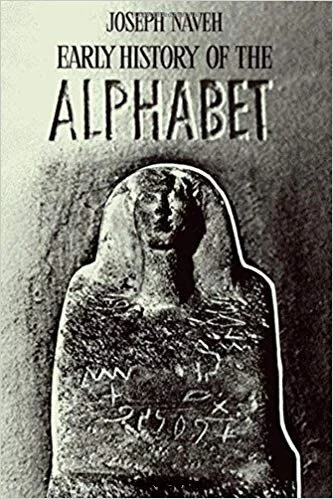
So we read that Joseph’s research is in line with Genenius showing that “E” and “O” only came about because they shifted from the original Phoenician writing system.
David Noel Freedman, Francis Ian Andersen, and A. Dean Forbes
David Noel Freedman (May 12, 1922 – 8 April 2008), son of the writer David Freedman, was a biblical scholar, author, editor, and archaeologist. He was one of the first Americans to work on the Dead Sea Scrolls.
Born 28 July 1925, Francis Ian Andersen is an Australian scholar in the fields of biblical studies and Hebrew. Together with A. Dean Forbes, he pioneered the use of computers for the analysis of biblical Hebrew syntax. He taught Old Testament, History, and Religious Studies at various institutions in Australia and the United States (including Macquarie University, the University of Queensland, and Fuller Theological Seminary). His published works include the Tyndale commentary on AiYuWB (Job), and Anchor Bible commentaries on HuWShA (Hosea), AMuWS (Amos), Habakkuk and Micah, and over 90 papers (some as co-author).
Together, these three scholars published a book (June 30, 1992) called “Studies in Hebrew and Aramaic Orthography” The purpose of this book is to introduce the student to the textual study of the Hebrew Bible. This is to help a student “perceive the work of the numberless and nameless scribes torn between tradition and fashion in their restrained attempts to update the orthography of Scripture.” Sixteen essays serve as the bridge from older methods for the study of orthography to newer ones, using the computer to analyze large bodies of text.
In the era of advanced technology, we recognize the constant evolution of information. Thanks to the capabilities of modern computing, we can revisit and reevaluate data, either obtaining new evidence or reinforcing established truths. This principle holds particularly true in the realm of forensics. The integration of powerful computers and artificial intelligence enables the reanalysis of old DNA and evidence. Criminals who believed they had evaded justice two decades ago are now facing incarceration, while individuals wrongfully convicted years ago are finding release due to the discovery of new evidence.
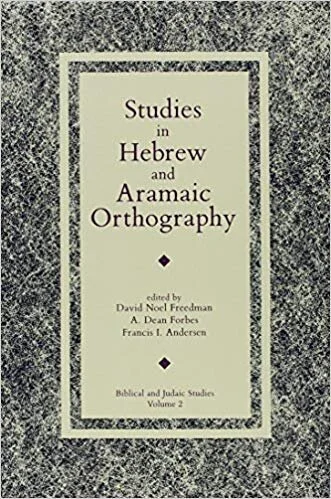
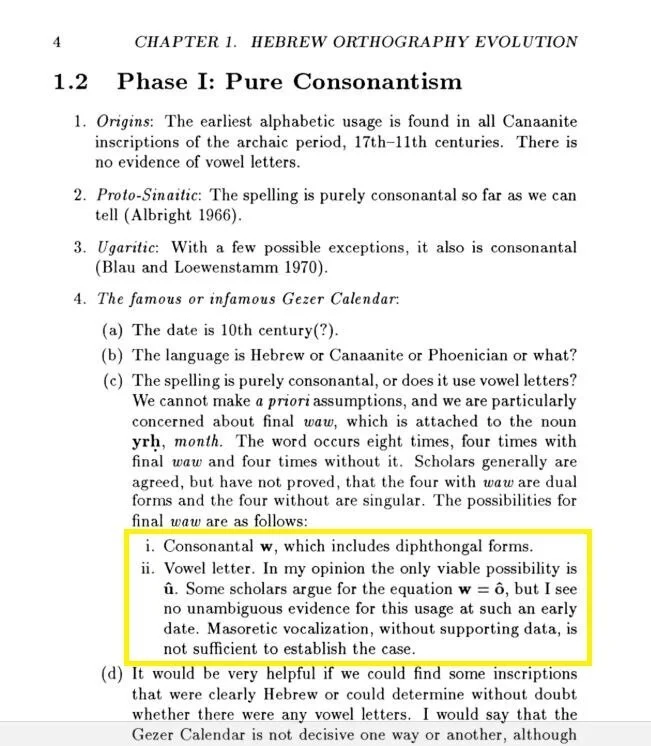
Here we read updated information STILL going back to support the original writing system established by the Phoenicians. They conclude that the ONLY viable vowel letter that can possibly work or be successful with the consonant Waw or W (which includes diphthongal forms) is U. They drive the point home by saying that there is no unambiguous (not open to more than one interpretation) evidence for the Waw being used as a vowel sound of “O”. So what he means is that ALL the ancient or original Semitic writing systems NEVER used the Waw (being a double letter) as an “O”. They go on to say that there is NO data to support or establish the case that the vowel of “O” is used with the consonant Waw. This is again why JeHoVaH, YeHoVaH, YaHoWaH, and YeHoWShuWA are ALL incorrect!
In this information (from 1992), we find continued support for the original writing system introduced by the Phoenicians. The argument maintains that the only viable vowel letter that can effectively complement the consonant Waw or W (including its diphthongal forms) is U. The assertion emphasizes the lack of unambiguous evidence supporting the use of Waw as a vowel sound for "O." In essence, the claim is that in all ancient or original Semitic writing systems, the Waw, being a double letter, was never employed as an "O." These three scholars conclusion dismisses the validity of using the vowel "O" with the consonant Waw, challenging the accuracy of forms like JeHoVaH, YeHoVaH, YaHoWaH, and YeHoWShuWA.
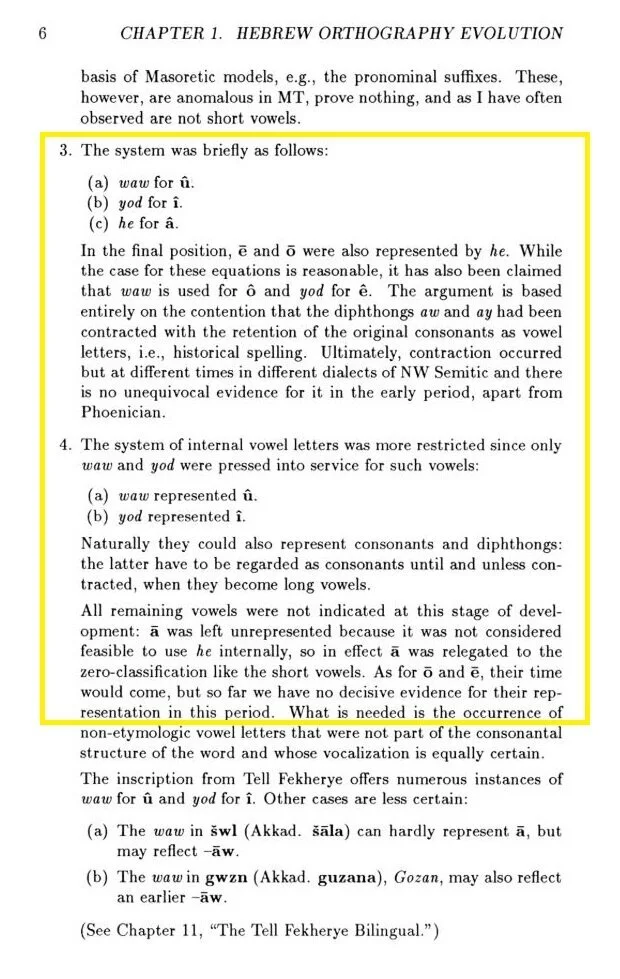
In chapter 6 they go on to say that those other dialects did occur but NOT in the original writing system. They explain that these contractions (Waw used for “O” and Yad used for “E”) occur but at a later time period. Once again they reiterate that there is NO unequivocal evidence of these contractions being used in the early period.
Arthur Walker-Jones
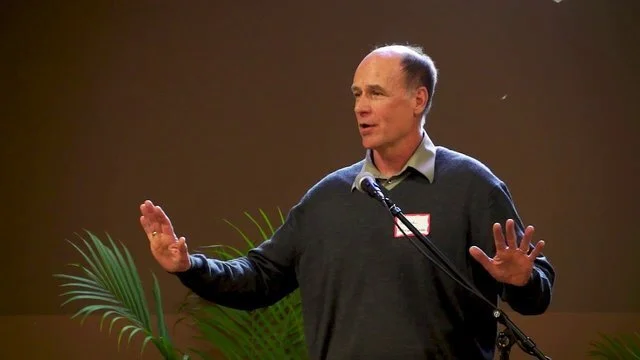
Arthur Walker-Jones has an M.Div. and Ph.D. from Princeton Theological Seminary and is the author of Hebrew for Biblical Interpretation and The Green Psalter: Resources for an Ecological Spirituality, as well as numerous, scholarly articles, chapters in books, and dictionary entries.
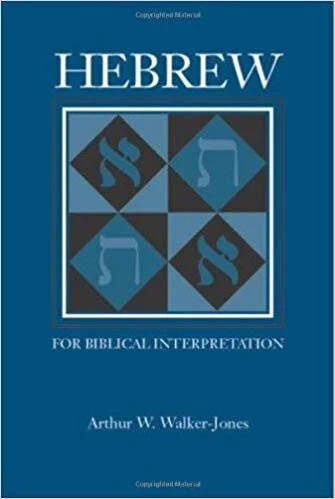
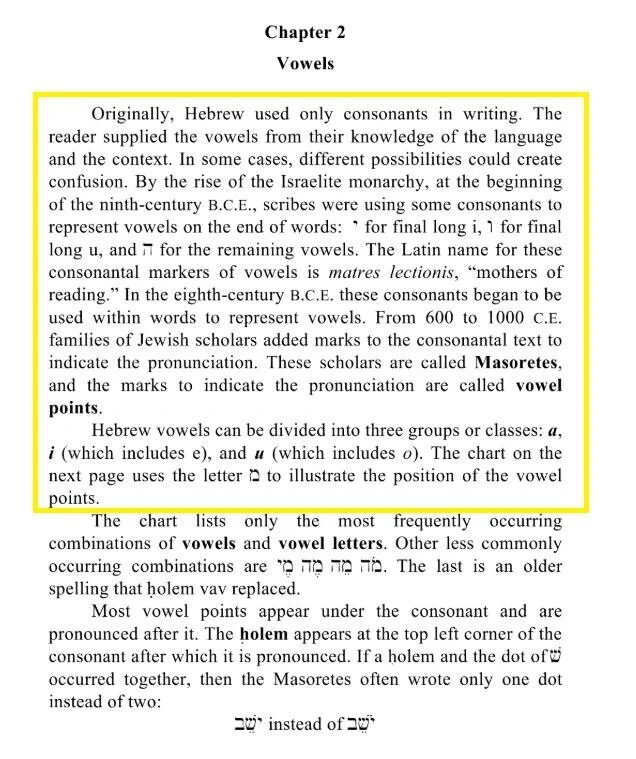
Arthur reinforces the concept that ancient Hebrew utilized an abjad system, consisting solely of consonants. The necessity for readers to supply vowels is emphasized, with their presence depending on the specific language or dialect, a factor that holds significant importance. The explanation highlights the various possibilities in the rendering and pronunciation of words, influenced by one's knowledge and contextual understanding of languages. Arthur aligns with the ancient written system, affirming the presence of the three original vowels— a, i, and u.
Yemenite Jews retain the ancient pronunciation
Linguistic study of the Yemenite Jews of Arabia
Yemenite Hebrew Pronunciation:
Historical Pronunciation: Yemenite Jews are known for preserving a pronunciation of Hebrew that is closer to what is believed to be an ancient form of the language. This includes pronouncing the waw as /w/, which is similar to the pronunciation in Arabic.
Differences: While Yemenite Hebrew does pronounce waw as /w/, not all aspects of their pronunciation align perfectly with what might be considered "ancient" or "pure" Hebrew. Pronunciations can vary even within Yemenite communities.
Comparison with Modern Hebrew:
Modern Israeli Hebrew: In contrast, Modern Israeli Hebrew pronounces waw as /v/ (a voiced labiodental fricative), which is different from the pronunciation in Yemenite Hebrew.
Arabic Influence:
Shared Features: Arabic and ancient Hebrew share some phonetic similarities, and both languages historically used the /w/ sound for the letter waw. Arabic has retained this pronunciation, whereas the pronunciation in Modern Hebrew has evolved differently.
Scholarly Sources:
"How the Hebrew Language Grew": This book by Edward Horowitz provides a historical perspective on the evolution of the Hebrew language. It may discuss the differences between various Hebrew pronunciations, including those of the Yemenite Jews.
Valid Scholarly Resources and Evidence:
"The Phonology of Hebrew" by Michael K. H. Kirchner: Offers a detailed analysis of the phonological aspects of Hebrew, including historical pronunciations.
"The Hebrew Language: A Historical Introduction" by William R. R. Phipps: Provides insights into the evolution of Hebrew phonology over time.
"A Grammar of the Hebrew Language" by William Gesenius: This classic work offers insights into ancient Hebrew pronunciation and its historical development.
In summary, Yemenite Jews do retain a pronunciation of waw as /w/, which aligns with its pronunciation in classical and Arabic contexts.
HEBREW AND ARAMAIC SCRIPT FACTS
Hebrew Square Script Derivation:
Claim: The Hebrew square script used today derived from Aramaic around the time of the Babylonian Exile.
Fact: This is correct. During the Babylonian Exile (6th century BCE), the Jews adopted the Aramaic script, which evolved into the square script used in Hebrew today. This script was used for writing Hebrew texts in the later periods of the Hebrew Bible and subsequent Jewish texts.
Source: Naveh, Joseph. "The History of the Hebrew Alphabet." (2002)
Aramaic as the Language Spoken by Jacob:
Claim: Aramaic was spoken by the biblical patriarch Jacob.
Fact: Aramaic was indeed a common language in the region during the time of the Christian New Testament messiah, so it is likely that he spoke Aramaic. However, Jacob is traditionally thought to have lived much earlier (around 2000 BCE), when the language spoken would have been different. The biblical text in Deuteronomy 26:5 refers to the patriarch Jacob as an "Arammiy/Aramite or Aramaean" (H761) in the context of his family background.
Source: Brown, Francis, S.R. Driver, and Charles A. Briggs. "The Brown-Driver-Briggs Hebrew-English Lexicon." (1906)
Arammiy/Aramean Definition and Origin:
Aramean (Aramaean): Refers to the people who spoke Aramaic, a Semitic language that became prominent in the Near East from the 10th century BCE onwards.
Historical Context
Geographical Location: The Arameans originated in what is now northern Syria and eastern Turkey. They settled in various regions of the Near East and established several small states.
Historical Significance: Arameans played a significant role in the history of the ancient Near East. Their language, Aramaic, became the lingua franca of much of the region from the 7th century BCE onwards, influencing the administrative and cultural life of empires such as the Assyrian and Babylonian.
Biblical Context
Biblical References: In the Hebrew Bible, the term "Aramean" (or "Aramite") is used to describe people from Aram (ancient Syria). Notable biblical figures such as Abraham's relatives, including his nephew Lot, were associated with this region.
Deuteronomy 26:5: Refers to Jacob (Israel) as a "wandering Aramean" which highlights his origins and the historical migration of his family.
Cultural Influence: The Arameans influenced the development of various aspects of culture and language in the Near East. Their language was adopted by many surrounding cultures, including the Jews during the Babylonian Exile.
Phonetic Analysis of the Sixth Letter
The "W" Sound for the Sixth Letter:
Claim: The Hebrew letter "vav" (ו) was pronounced as "w" and not "v" in ancient times.
Fact: In early Semitic languages, the letter "vav" (ו) represented a "w" sound. In later periods, especially in Biblical Hebrew, its pronunciation shifted to "v." This change is supported by phonological studies of ancient Semitic languages and their development.
Source: Glinert, Lewis. "The Grammar of Modern Hebrew." (1989)
Comparison with Ugaritic, Arabic, Maltese, and Ge’ez:
Claim: Ugaritic and later Semitic languages use a double “u” for the letter, challenging the idea that the sixth letter had the sound of “v” in ancient times.
Fact: Ugaritic and Arabic indeed have different phonetic values for their corresponding letters. For instance, Ugaritic used a “w” sound, which is comparable to the early pronunciation of "vav." The letter evolved across languages, reflecting various phonetic developments.
Source: A. Oppenheim, "Ancient Mesopotamia: Portrait of a Dead Civilization." (1977)
Summary:
The Hebrew square script did indeed derive from Aramaic, and the phonetic evolution of the letter "vav" is well-documented. The shift from "uw" to "v" in pronunciation is supported by historical linguistics and cross-linguistic comparisons.
THE THREE VOWELS a, i, and u
The Yad, Hay, and Waw are three consonants that can take on vowel sounds. Remember we are chasing sound and unlike the English, the ABaRiY (aka Hebrew) consonants DO NOT always take on the sounds that English consonants would.
VOWEL a
Some examples of the a or “Ah” sound show that the vowel “a” comes between Hebrew consonants in names or words.
BaRaK: English translation is bless
NOTE: remember there is NO consonant or letters “E” in ABaRiY
ABaRiY / Hebrew: ברכ = BRK = BaRaK
pronounced: Ba - RaK
MuWShaH: English translation is Moses
NOTE: remember there is NO consonant or letters “O” or “E” in ABaRiY
ABaRiY / Hebrew: מושה = MWSH = MuWShaH
pronounced: MuW- ShaH
VOWEL SOUND i
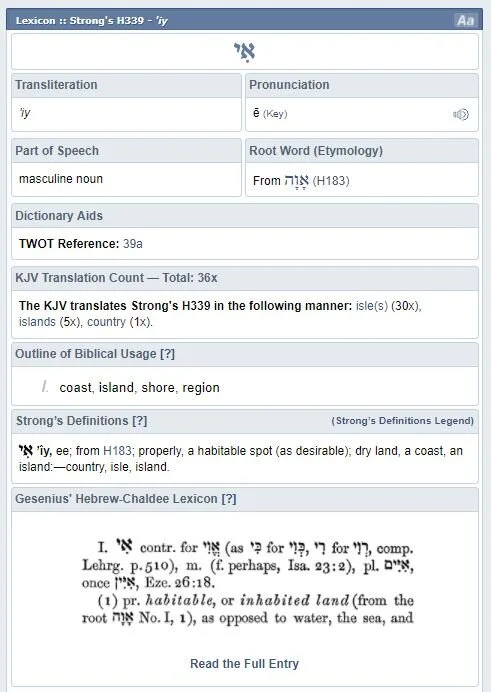
Unlike English, the Hebrew vowel sound of “i” is not like in “ice”, but makes an “EE” sound like in “Easter”. Below are some examples of the “i” or “EE” vowel sound. The “i” vowel ALWAYS comes before the Hebrew consonant Yad (consonant “Y” in English or Yod in modern Hebrew), in names or words, unless the “Yad” (or “Y”) starts a word or name.
ALiYaHuW: English translation is Elijah
NOTE: remember there is NO consonant or letter “E” or “J” in ABaRiY
ABaRiY / Hebrew: אליהו = ALYHW = ALiYaHuW
pronounced: AL- “EE” - YaHuW
YaRaMiYaHuW: English translation is Jeremiah
NOTE: remember there is NO consonant or letter “E” or “J” in ABaRiY
ABaRiY / Hebrew: ירמיהו = YRMYHW = YaRaMiYaHuW
pronounced: YaRa - M“EE” - YaHuW
ALuWHiYM: English translation is gods
NOTE: remember there is NO consonant or letter “O” in ABaRiY
ABaRiY / Hebrew: אלוהים = ALWHYM = ALuWHiYM
pronounced: Ah- Luw - H“EE” M
English translation: Urijah
NOTE: remember there is NO consonant or letter “U” or “J” in ABaRiY
ABaRiY / Hebrew: אוריהו = AWRYHW = AuWRiYaHuW
pronounced: Ah - “OO” - R“EE” (or Auri) YaHuW
ABaRiY: English translation is Hebrew
NOTE: remember there is NO consonant or letter “E” in ABaRiY
ABaRiY / Hebrew: העברי = HABRY = Ha’ABaRiY (the “Ha“ is a prefix and means “the”, so “the ABaRiY”).
pronounced: Ah- Ba - R“EE”
VOWEL SOUND u
As the Greeks adopted their alphabet and vowel sounds from the Phoenicians, they recognized the dual nature of the WaW (or consonant "W" in English). It served as both the initial consonant, akin to the English "W" in words like "water," producing the “Wa” sound, and as a vowel "uW" (oo sound) as in words like “blue” or “ShuWA” (meaning “to cry out”).
Despite variations in English spellings such as ShuWaH or ShuA for the last part of YaHuWShuWA (H3019 , the son of NuWN or Joshua), the Hebrew evidence indicates that ShuWA is represented by three letters שוע, not 5 שועה or 2 שע. It's crucial to recognize that altering the spelling of a Hebrew name changes its meaning, character, identity, and purpose, with the “u” consistently preceding the “WaW” (or consonant W) unless the WaW initiates a name or word.
ShaLuWM: English translation is shalom
NOTE: remember there is NO letter “O” in ABaRiY
ABaRiY / Hebrew: שלום = SLWM = ShaLuWM
pronounced: Sha- L “oo” M
YaHuWaH: English translation is yehovah
NOTE: remember there is NO consonants or letters “E” or “O” or “V” in ABaRiY
ABaRiY / Hebrew: יהוה = YHWH = YaHuWaH
pronounced: Ya - H“OO” - WaH
ShAuWL: English translation is Saul
NOTE: remember there is NO consonant or letter “U” in ABaRiY
ABaRiY / Hebrew: שאול = SAWL = ShAuWL
pronounced: Sha - “OO” - L
ThuWRaH: English translation: Torah
NOTE: remember there is NO consonant or letter “O” in ABaRiY
ABaRiY / Hebrew: תורה = TWRH = TuWRaH
pronounced: T “OO” - RaH
VOWEL POINT SYSTEM
Even when you using the niqqud vowel point system, here are some examples of words or names that make the “oo” sound when the Waw is involved. Although these vowel points look different (the Shuruk וּ and the Kubutz שֻׁ) they both make the “oo” sounds like in the words “Blue or Moon”.
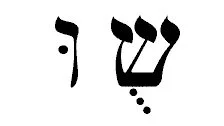
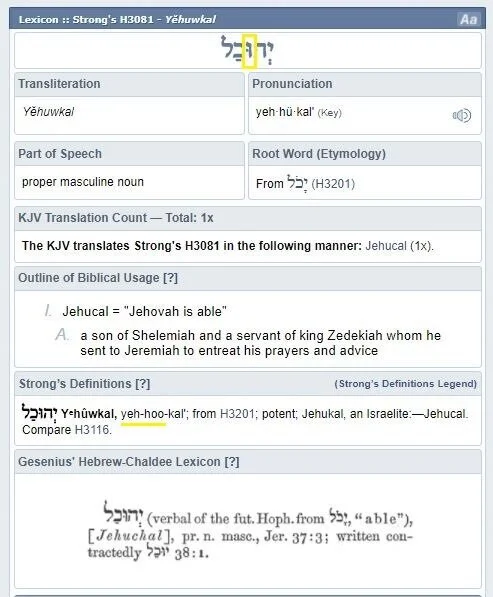
Let’s take a look a the Shuruk in the name YaHuWKaL
יְהוּכַל = LKWHY = YaHuWKaL
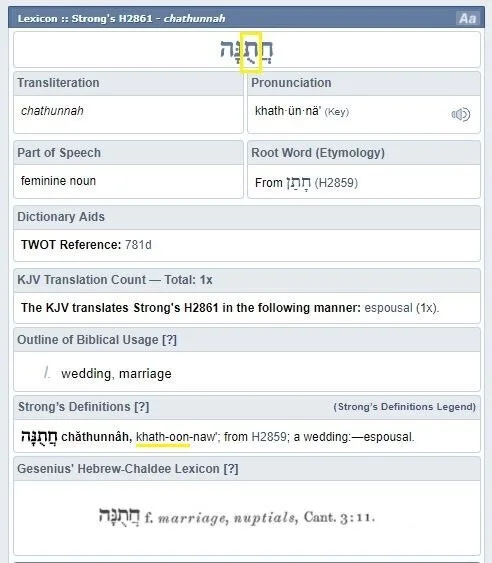
Let’s take a look a the Kubutz in the word KhaThuWNaH
חֲתֻנָּה = HNWTK = KhaThuWNaH H2861
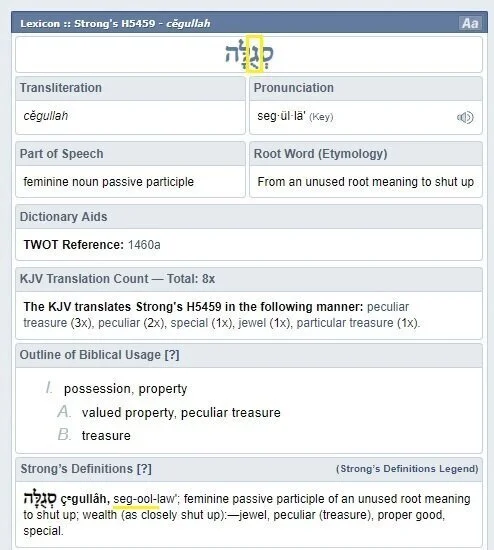
סְגֻלָּה = HLWGS = SaGuWLaH H5459
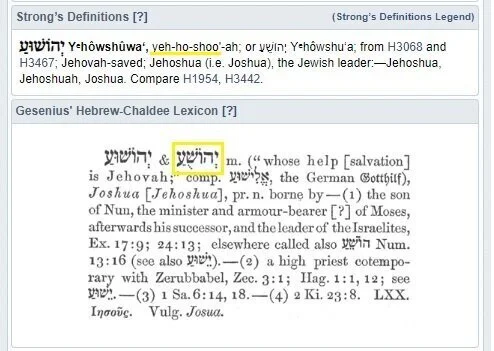
יְהֹושֻׁעַ = AWSWHY = YaHuWShuWA H3091
THE PRE-TONAL SHORTENING RULE
The concept of "pre-tonal shortening" in Hebrew refers to a phonological phenomenon where vowels before the stressed or tonal syllable in a word undergo shortening. This shortening occurs in certain grammatical contexts and can be observed in the pronunciation of words. The term "pre-tonal shortening" is not a traditional or widely recognized term in Hebrew linguistics. Instead, it seems to be a description of a phonological pattern observed in the language. The phenomenon has been present in Hebrew for a long time and is not a recent development.
The phenomenon of pre-tonal shortening in Hebrew is not something that was created at a specific point in time; rather, it is a natural linguistic development that has evolved over the course of the language's history. Linguistic changes, including alterations in vowel length and pronunciation patterns, can occur gradually over generations. Hebrew has a long linguistic history, with roots dating back to ancient times. Changes in pronunciation and phonological patterns have occurred over the centuries, influenced by various factors such as linguistic contact, social changes, and the natural evolution of language.
In Modern Hebrew, the pronunciation of the divine name is often adapted based on traditional Jewish practices of avoiding direct vocalization of the Tetragrammaton. When reciting the biblical text, many Jewish readers use substitutes, such as "Adonai" (Lord), "HaShem" (The Name), or other circumlocutions. The specific pronunciation can vary among individuals and communities.
Phonological Shift: The Evolution of Hebrew Pronunciation
The sound shift from the "waw" sound to the "vav" sound in Hebrew pronunciation is a notable linguistic phenomenon that occurred over time in the historical development of the Hebrew language. This change is referred to as a phonological shift, where the pronunciation of a particular sound evolves within a language.
Sources for further reading on this topic can include:
Hebrew Linguistics Books: Books on Hebrew linguistics, such as "The Phonology and Morphology of Biblical Hebrew" by Joshua Blau or "A History of the Hebrew Language" by Angel Sáenz-Badillos, may discuss this phenomenon in detail.
Academic Journals: Scholarly journals focused on Semitic languages and historical linguistics often contain articles discussing phonological changes in Hebrew. Journals such as the "Journal of Semitic Studies" or "Hebrew Studies" may have relevant articles.
Historical Linguistics Textbooks: Textbooks on historical linguistics provide insights into how languages change over time. Books like "Historical Linguistics: An Introduction" by Lyle Campbell or "The Oxford Handbook of Historical Phonology" may discuss Hebrew phonological changes.
Online Resources: Websites and online databases such as JSTOR, Google Scholar, or Academia.edu can be valuable resources for accessing scholarly articles and papers on Hebrew linguistics and historical phonology.
By consulting these sources, you can gain a deeper understanding of the sound shift from "waw" to "vav" in Hebrew pronunciation and its implications for the historical development of the language.
conclusion
Research educates us that the letter "V" is considered to have originated from the Phoenician letter "Waw" (also known as "Vav" in modern Hebrew). The Phoenician alphabet is one of the earliest known writing systems and served as the basis for various later alphabets, including the Greek and Latin alphabets.
The Phoenician "Waw" represented a consonantal sound, similar to the English "W." As the alphabet evolved and was adopted by different cultures, the pronunciation and form of certain letters changed. In the case of the letter "V," it is believed to have developed from the Phoenician "Waw."
The distinction between the letters "U" and "V" evolved over time. The differentiation between the two letters is not as ancient as the Phoenician alphabet but occurred during the development of the Latin alphabet.
In Gothic scripts from 1386, the form of the letter "V" was used both for the consonantal sound "V" and the vowel sound "U." The distinction between the two sounds became more standardized in the mid-16th century when the modern letter "U" was established to represent the vowel sound, and "V" continued to represent the consonantal sound. So, the evolution of the Latin alphabet contributed to the separation of "U" and "V" as distinct letters with specific phonetic roles.
The capital "U" was not accepted as a distinct letter until many years later. The letter "U" as a separate entity from "V" was a development in the evolution of the Latin alphabet. We recognize that all Semitic languages (such as Phoenician, Hebrew, Aramaic, Arabic, Ethiopic, etc.) share a common origin and have three common elements: the original pure vowel sounds of a, i, and u.
Having established that "W" predates "V" and "U" can only derive from "W" as a vowel, there is only one conclusion concerning the accurate spelling of the true name of the God of Israel:
"YaHuWaH"
OTHER RESOURCES
Sources for further reading on this topic can include:
Hebrew Linguistics Books: Books on Hebrew linguistics, such as "The Phonology and Morphology of Biblical Hebrew" by Joshua Blau or "A History of the Hebrew Language" by Angel Sáenz-Badillos, may discuss this phenomenon in detail.
Academic Journals: Scholarly journals focused on Semitic languages and historical linguistics often contain articles discussing phonological changes in Hebrew. Journals such as the "Journal of Semitic Studies" or "Hebrew Studies" may have relevant articles.
Historical Linguistics Textbooks: Textbooks on historical linguistics provide insights into how languages change over time. Books like "Historical Linguistics: An Introduction" by Lyle Campbell or "The Oxford Handbook of Historical Phonology" may discuss Hebrew phonological changes.
Online Resources: Websites and online databases such as JSTOR, Google Scholar, or Academia.edu can be valuable resources for accessing scholarly articles and papers on Hebrew linguistics and historical phonology.
By consulting these sources, you can gain a deeper understanding of the sound shift from "waw" to "vav" in Hebrew pronunciation and its implications for the historical development of the language.
Unlearn, Deprogram, and Re-think EVERYTHING you were taught!
We don't claim to be self-professed prophets, teachers, leaders, or mentors, and we're not part of any clique, sect, or recruitment center. The resources mentioned on our website and YouTube channel, such as Strong's Concordance, Encyclopedia Britannica, the dictionary, word etymology, etc., serve as tools for a broader perspective. Nonetheless, our ultimate trust remains in the unchanging ToRaH of the Creator and God of Israel. We always encourage everyone to measure all opinions against the unchanging ToRaH of the Creator and God of Israel.
BaT DaBaR 7:14 “2 Chronicles” Hebrew ToRaH
14 When my people, who bear MY NAME humble themselves, pray, and seek my favor and TURN from their evil ways; I will hear in my heavenly abode, and FORGIVE their sins, and will heal their land.
MaKhiYaH 6:8 “Micah”
8 He hath shewed thee, O man, what is good; and what doth YaHuWaH require of thee, but to do justly, and to love mercy, and to walk humbly with thy ALuWaH?
ZaMaR 119:10-11 “Psalm”
10 With my whole heart have I sought thee: O let me not wander from thy commandments.
11 Thy word have I hid in mine heart, that I might not sin against thee.